


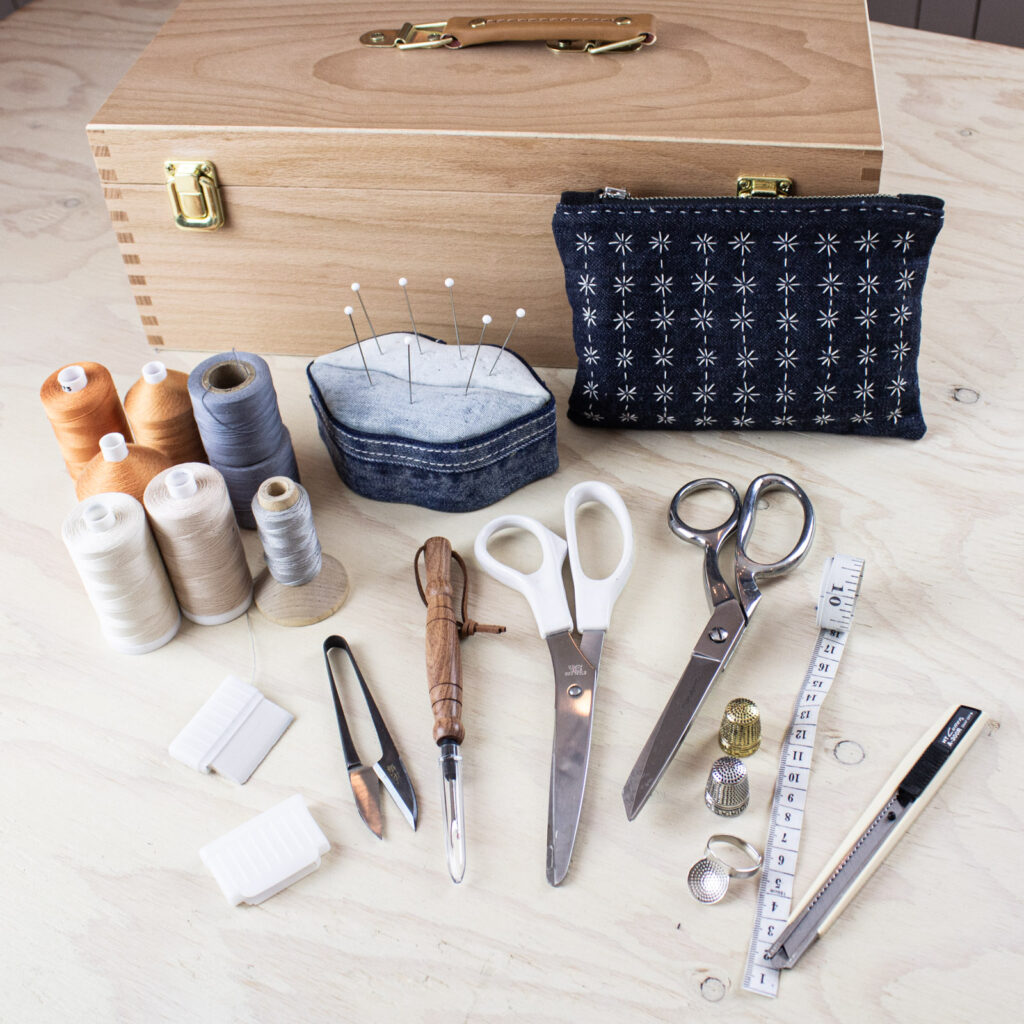
I started sewing at 12 with tools I found at thrift shops, and if you’re just starting, I recommend doing the same. A needle, thread, scissors, measuring tape, and pins—plus a few pairs of old jeans, a couple of ideas, and a bit of courage—and voilà!
That being said, each item in these kits has been carefully curated and personally tested by me. I value tools that are built to last and perform. Whether you’re looking to invest in the right tools from the start or upgrade your current setup, this page has you covered.
WHAT’S IN MY SEWING POUCH KIT

In my little sewing kit, I keep the tools I love having close by at all times. They live next to my machine or in my toolbox, and they’re easy to carry if I feel like sewing in the living room, outside at the park, or at a picnic table.
Want to make your own kit? Here’s the link to my tutorial. It's simple and completely hand-sewn, no sewing machine needed!
THE SEAM RIPPER


A must-have! Everyone ends up needing to rip out stitches at some point. If you’re thrifting, you might score one, but if you’re buying online, I recommend a model with a long handle—it’s more comfortable and precise.
→ My deluxe pick (Amazon link)
→ My budget-friendly pick (Amazon link)
HAND SEWING NEEDLES


There are so many types of needles out there. What you really need to remember is this: you choose your needle based on the fabric and the thread you plan to use. A lightweight fabric? Go for a fine thread and a thinner needle. A thick, dense fabric like denim? You’ll want a sturdier thread and a more rigid needle. It’s also a matter of feeling—experiment with what you have on hand.
There are two main categories of needles: hand-sewing needles and machine-sewing needles. The hole in the needle is called the eye, and that’s where your thread goes. On hand-sewing needles, the eye is at the top; on machine needles, the eye is near the bottom. If you’re struggling to get your thread through, it might not be the right needle for that thread.
I recommend getting a variety pack of needles and just playing around with them. Please, get a set that comes in cardboard packaging—the ones in those plastic wheels are the worst! The needles get stuck, and honestly, they’re a nightmare to use. Lol!
→ Mon assortiment d’aiguilles à main préférés (Amazon link)
→ My visible mending needle set (Amazon link)
LES AIGUILLES À MACHINE À COUDRE POUR LE DENIM

→ Home sewing machine needle assortment (Amazon link)
→ My industrial sewing machine needle assortment (Amazon link)
THREAD SNIPS

Of course, you can use scissors to cut thread, but scissors have long blades that aren’t as precise as thread snips. When cutting thread with scissors, it’s easy to accidentally snip your fabric by mistake. I really recommend using thread snips instead. I love the Yoshihiro Nigiri Hasami 105 mm — they’re a bit more expensive, but they’re made from a single piece of metal, with no plastic parts, which makes them more durable. Plus, they’re made in Japan.
→ My deluxe thread snips (Amazon link)
→ My more affordable pick (Amazon link)
SEWING THREADS

If you sew denim and live in North America, buy from WawakThey don’t sell on Amazon, but their website is really easy to use.
→ Denim thread Perform-X Cotton Wrapped Poly Core Thread – Tex 80 – 750 yds
→ Topstitching thread Perform-X Cotton Wrapped Poly Core Thread – Tex 60 – 750 yds
→ Fil 100% coton organique thread and live in Europe, I buy mine from this address: Organic Cotton Plus.
MESURING TAPE

Let’s be real—there’s no design, designer, sewist, or denim upcycler without a measuring tape. It’s an absolute essential, both for functionality and style. 😉
When it comes to measuring tapes, I keep it classic: black and white, no countainers as I like to style it around my neck. As a true Canadian navigating between imperial and metric systems, my measuring tapes must have both.I also like to have several on hand. There’s one tucked away in my sewing machine drawer, another in my sewing box, and a third in my hand-sewing kit. I can almost guarantee there are a few more scattered around the house! One of my favorites is a vintage measuring tape I found at a garage sale. It’s purely decorative—the tape is made of cotton with printed measuring lines and stored in a leather container. It’s quite epic! These Amazon ones may not be as epic, but they’ll definitely be your go-to tools for creating your own epic projects.
→ My go-to measuring tape (Amazon link)
THE FABRIC CHALK

Tailor's chalk is an essential tool in any sewing kit. It’s the same type I was introduced to in fashion school over 20 years ago. Today, there are so many options on the market—fabric markers, powder chalk, wax, and more, in all shapes and forms. Out of curiosity, I’ve tried them all, but I always find myself coming back to this classic chalk. It’s simple, reliable, easy to store in your sewing kit, and incredibly easy to use. Plus, it feel like the most sustainable option—no waste, no fuss, just a timeless sewing staple.
→ My favorite chalk (Amazon link)
THE SEWING THIMBLE

I love sewing thimbles and usually thrift them. Some of my favorite finds have been amazing vintage pieces from brocantes. As someone who loves hand sewing, thimbles are an absolute essential—it’s hard to imagine stitching without one! What I adore most about hand sewing is its portability. You can do it anywhere: in front of the TV, in the kitchen, in bed (yes, I live dangerously), or even outside in parks or at the beach. Maybe that’s why I keep losing my thimbles so often!
When I can’t find any at thrift shops, these have become my go-to thimbles. I’ll admit, I’m a bit old school when it comes to thimbles—I’m all about classic metal ones. Please, no plastic or silicone for me!
→ My favorite thimble (Amazon link)
SAFETY PINS

Diaper pins are very useful for pinning two layers of fabric together, and make reference point. They are also very useful while making adjustment and alterations, to mark the new height of a trouser hem for instance, etc.
→ My safety pin choice(Amazon link)
THE POINT TURNER

For years, I’ve been upcycling old jeans into mittens, which became my signature product and a customer favorite. I’ve sewn thousands of pairs! These mittens were quite fitted, and one of the most challenging steps was turning them right-side out before inserting the lining—a daunting task. That’s where this point turner came to the rescue. It made shaping the thumb and inserting the lining quick and effortless. This tool is hands down the number one sewing tool you didn’t know you needed!
→ My go-to point turner (Amazon link)
MY BIG SEWING BOX


I usually thrift my sewing cases, but funny enough, I tend to look for makeup boxes or even actual toolboxes instead. Traditional sewing boxes often come with those three-tiered compartments that open up on both sides. While they’re classic, I find they take up way too much space on the sewing table. I prefer a compact sewing toolbox, and this particular one is super handy—not too big and very practical. You can customize the compartments, and the top section is perfect for storing scissors. If you don’t feel like hunting for one in thrift shops, this is a great option to consider!
In the large kit we find essentially the same thing as in the small sewing kit, but in greater quantity and/or variety. Chalks, pencils, eraser, small ruler, pins, needles of all kinds.
→ My sewing box (Amazon link)
BOBBINS CASE BOX

Before Amazon, my go-to container for storing my bobbins was often a Mason jar. I inherited the bobbin Mason jar from the previous owner of my industrial sewing machine, and I kept it for years. But honestly... it was always a real mess. The jar even contained bobbins that didn’t fit my machine, but I kept them anyway. The threads would get tangled, and every time I tried to pull one out, a dozen would come with it—all knotted and in disarray.
Okay, I admit it: I'm not a big fan of plastic or silicone for sewing tools, and I always try to recommend alternatives. But in this specific case, this bobbin case is really great. The plastic withstands occasional drops, and even though the lid might open if it falls, the silicone compartments keep the bobbins securely in place. The Mason jar did the job, but here’s a modern tool that seems unnecessary... until you try it.
Little tip: make sure to choose the right size for your bobbins!
→ My bobbin box (Amazon link)
THE MAGNETS

Always handy for picking up dropped pins (and yes, they can save you a trip to the ER—true story, lol).
→ My basic magnets (Amazon link)
FABRIC SCISSORS


I’ve had my sewing scissors since fashion school, 20 years ago. It’s the model we were asked to buy back then. Since then, I’ve acquired several other pairs of fabric scissors, but these are still the ones I prefer. I love their size: not too big, not too heavy, easy to handle.
Some pinking shears help prevent fabric from fraying too easily. They can be useful, but they’re not a necessity.
Those all-purpose scissors are for cutting paper and patterns. These are my favorites—just the right size.
→ Sewing scissors (Amazon link)
→ Pinking shears (Amazon link)
→ All-purpose scissors (Amazon link)
X-Actos


I use an X-Acto a lot. I use a larger larger X-Acto as a cutting tool. It saves me from having to trace the pattern onto the fabric. I just lay the pattern on the fabric and cut directly with the X-Acto. Faster!
to deconstruct old jeans before giving them a second life. plus petit X-Acto pour déconstruire les vieux jeans avant de leur offrir une seconde-vie.
→ Small X-Acto (Amazon link)
→ Larger X-Acto (Amazon link)
Graded rulers

A must if you’re drafting your own patterns or doing visible mending.
→ Metric ruler (Amazon link)
→ Imperial ruler (Amazon link)
Iron

A sewing machine + an iron = the dream team. A good press makes all the difference in your finished project!
→ Mon fer à repasser (Amazon link)
→ Ironing board: ( Lien Amazon)
VISIT YOU NEAREST THRIFT SHOP BEFORE BYING ON AMAZON
Saint-Vincent-de-Paul, The Salvation Army, the clothing counter close to your home… you might be able to find sewing tools you need second-hand for next to nothing. Before clicking on an Amazon link, ask around or post on Facebook saying you're looking for sewing tools. Many people have it from their grandmother, but do not use it. Do not hesitate if you have any questions, write a comment bellow this article :)
Donna Chase
Love this information. Beautifully written, easy to understand, invaluable information, motivating. Just fabulous. Thank you.
Sincerely,
Donna Chase
ariane
Hi Donna,thank you so much for taking the time to right this comment! It is making my day;)