


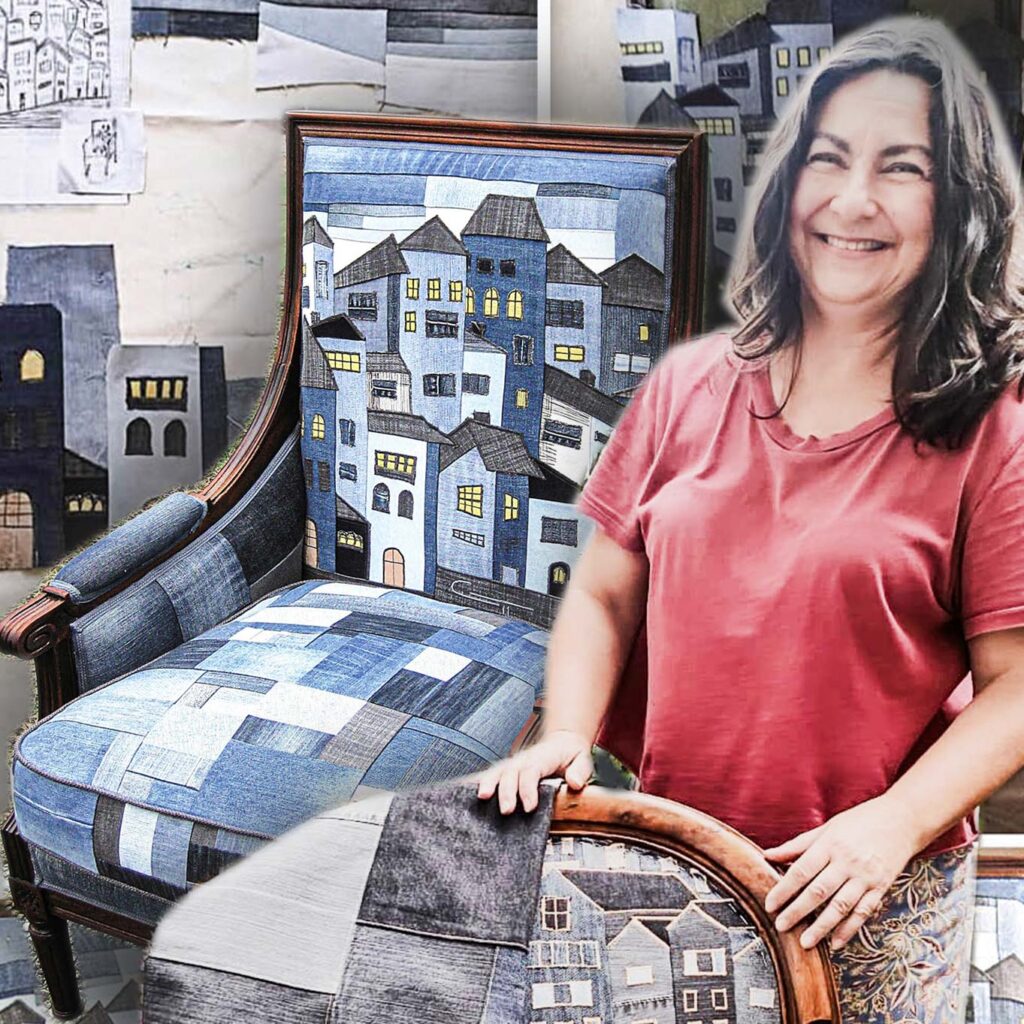
Lately, I’ve been captivated by the denim cityscapes emerging in our Facebook community. Tiny stitched houses, patchwork streets, and skylines made entirely from old jeans. I even created a full gallery to showcase them check the inspiration gallery from our community..
I keep wondering what draws us to this theme? Is it the joy and hope of rebuilding, or perhaps a quiet reflection on belonging and loss?
Tracing back the roots of this creative wave in our Facebook group, I stumbled upon the incredible work of artist Svetlozara Panayotova. Her work beautifully blends upcycled denim and upholstery fabrics into intricate cityscapes that feel both nostalgic and full of life.
Curious to know more, I reached out to Svetlozara with a few questions. She kindly shared her insights, along with more photos of her inspiring creations. Dive in below to discover her process, her favorite tools, and what fuels her imagination. I hope you’ll enjoy this interview as much as I did.
Find her work on : Facebook : sv.panayotova Instagram : azara.art.patchwork
Ariane xo
Background & Inspiration

Plovdiv, Bulgaria / Photo credit Wkimedia.org
Where are you from, and when did you start creating denim cityscapes?
I was born and raised in Bulgaria but I have been living in Germany for the last 10 years. I am a civil engineer by education and have been practicing this profession to this day as my full-time job. However, outside of work imagination has no limits. I have a love for beauty, I consider myself a creative person with a passion for aesthetics and design. So with this and a certain amount of dexterity patchwork is my art of choice.
It turns out that I've been doing patchwork since before I knew such a thing existed. I reupholstered my first chair when I was in university in my student dorm. I had two options - to either fix it or throw it away so I decided to cut up two old skirts and sewed a "damask" out of them, which I then nailed to the chair. The result was satisfactory for what I needed at the time. Fast forward almost 30 years later, this has become my true passion and something I can proudly say I do very well.
Where do you find your inspiration when creating cityscapes?
I'm not afraid to experiment, both in my hobby and in life. When I headed to Germany for a new life challenge, I was lucky enough to find myself in the wonderful Allgäu region with its beautiful nature and small towns with magnificent old buildings and narrow stone streets, which inspired the urban landscapes you can see in my artworks.

Allgäu, Germany / Photo Credit: Wikipedia

Like any beginning, this was not easy and for a long time I was careful to pack my luggage into “one suitcase” so that I could easily move. However, my creative needs needed expression, so I bought a regular sewing machine and started making small patchwork items to create coziness in my new small home. In order not to overfill the suitcase, I started using old jeans and other textile materials, given to me by friends or purchased at flea markets, traditionally organized in the area. This is how I discovered denim as a material.
Why denim? What makes this material so special to you?
Denim is a very durable and easy-to-work with material. The variety of shades of one color creates balance in the whole picture of the artwork and an impressive, nuanced effect. These properties make the fabric a perfect material for both textile painting and upholstery.

Pssst! You like this blog post? Subscribe to our denim upcyclers newsletter!
Creative Process & Materials

Photo credit: Svetlozara Panayotova
How do you choose the pieces of furniture you upcycle?
I find antique armchairs at flea markets, thrift stores or on different websites where they sell second-hand furniture and home pieces. I believe that the style of the furniture should match the artwork I upholster on them. For example, a painting of an old town corresponds well with an antique armchair with a more baroque feel to it. Thus, in an eclectic style (mixing styles - an antique chair and non-traditional fabric). I like to achieve harmony and maintain balance while not being afraid to play with different styles.
What’s your favorite tool when “painting” with denim?
Based on patchwork and quilting, I have created my own technique for making my textile paintings. I use a regular sewing machine with a straight and zig-zag stitch and the standard patchwork tools - a cutting board, ruler and circular knife. All pieces of fabric are sewn.


I do not have my own studio or atelier; I have created my small creative corner in my apartment and I do all of my upholstery processes on my patio outside. The selection of textiles for each project is individual, so that the colors match within the available shades.


Photo credits: Svetlozara Panayotova
How long can it take to make a piece like one of those outstanding antique chairs?
Renovating each chair is extremely laborious and time-consuming – from the idea, through the production of textile paintings, dismantling and restoring the wooden parts of the chair and the new upholstery. At the same time, it encompasses knowledge of both patchwork and restoration as well as upholstery. I could not give an estimate of the time, but each of my chairs have taken me hundreds of hours.
Artistic Choices & Meaning


Photo credits: Svetlozara Panayotova
When creating a cityscape, do you have a specific city or neighborhood in mind? Do you use photographs as references?
My cityscapes are a collective image of different impressions I have gathered from many cities and towns. What I do is I make small rough sketches of an idea I have in mind, which undergoes many changes while working on it. An exception is the armchair "At Dawn", which is based on a photograph of the Alhambra Palace in Spain. At Dawn, inspiré d’une photo du palais de l’Alhambra, en Espagne.
Your cityscape houses have a distinctive personality. How do you approach illustrating homes, and what does “home” mean to you?
A home is that which carries the reflection of the soul of its inhabitants. This is probably the case with my cityscapes, and this gives them their distinctive character. Each of my works is based on my own project and, in addition to the style, is recognizable by my signature - my initials in Cyrillic, the alphabet of my native language. "СП" which you can see sewn into my artworks stands for “SP”(Svetlozara Panayotova). All of my works have names.
Tips and tricks

Crédit photo: Svetlozara Panayotova
What advice would you give to someone who wants to explore the art of creating cityscapes with upcycled denim?
Don't be afraid to try. The project (sketch) should not limit you, in the process of work it is normal for the idea to undergo change and develop. Give yourself the freedom to be creative. Deviating from the sketch is not a mistake, and no one knows about the sketch. In the end everything is subjective and a part of the designer’s vision and decision.
It is not mandatory to have a workshop and professional tools, but you will inevitably need to stock up on a few necessary, albeit amateur ones.
Svetlozara’s story reminds us that creativity can spark anywhere... on a balcony, around a sewing machine, or through a handful of old jeans. Her cityscapes reflect something deeply human: our shared need to build, rebuild, and belong.
She’s part of a growing wave in our Denim Upcyclers community, where denim upcyclers from around the world stitch their own versions of home.
Explore more inspiring creations in our Denim Cityscapes Inspiration Gallery and maybe start envisioning your own denim neighborhood!
Ariane xo 💙
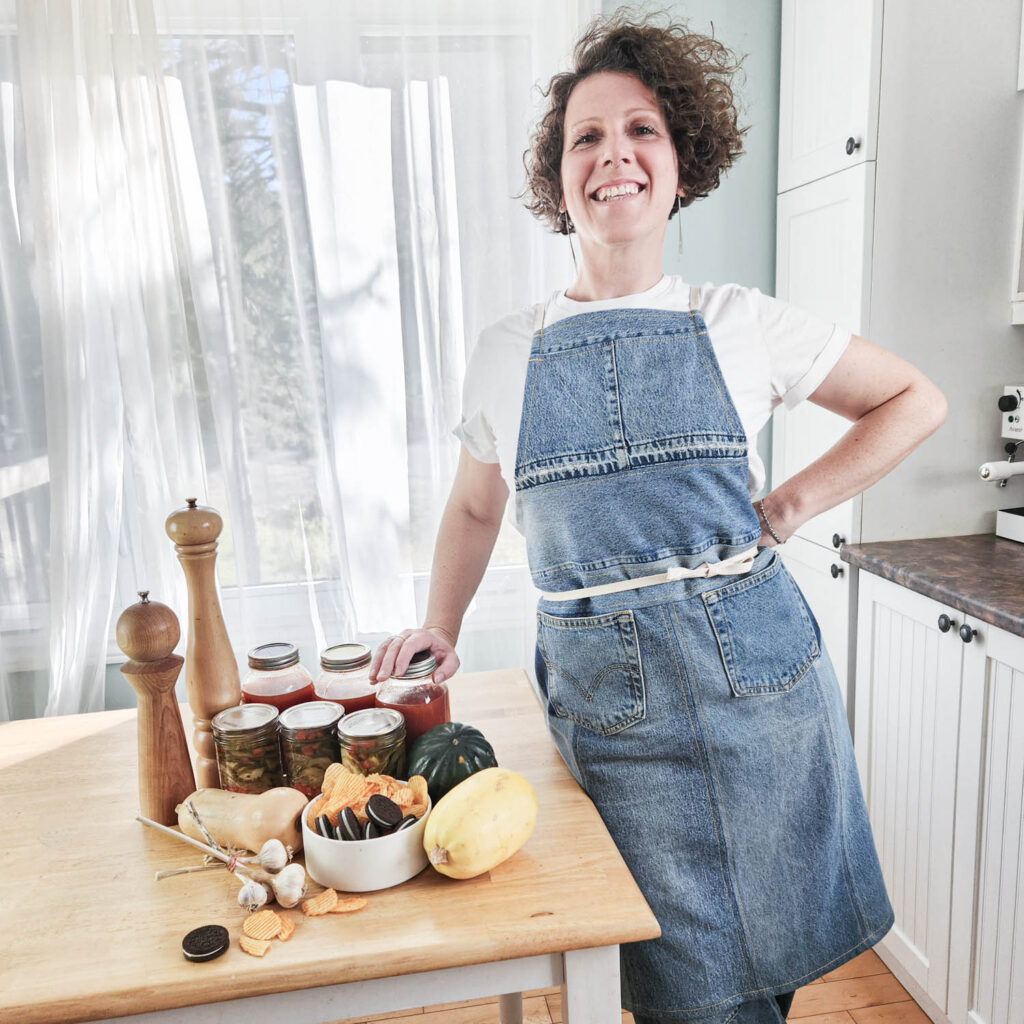
Want to start a sewing project? Why not make an apron?
A perfect beginner-friendly project — great to make for yourself or to give as a gift :)
Kathleen
How could anyone ever consider actually sitting on these masterpieces?! The artistry is inspiring! Thank you for sharing these photos.
ariane
I know right! Let say it falls more on the piece of art then on the piece of fourniture;)
VERNIAUD Bernadette
Ok pour publier des ouvrages
Merci beaucoup VERNIAUD Bernadette
ariane
Heureuse que vous ayez apprécié:)